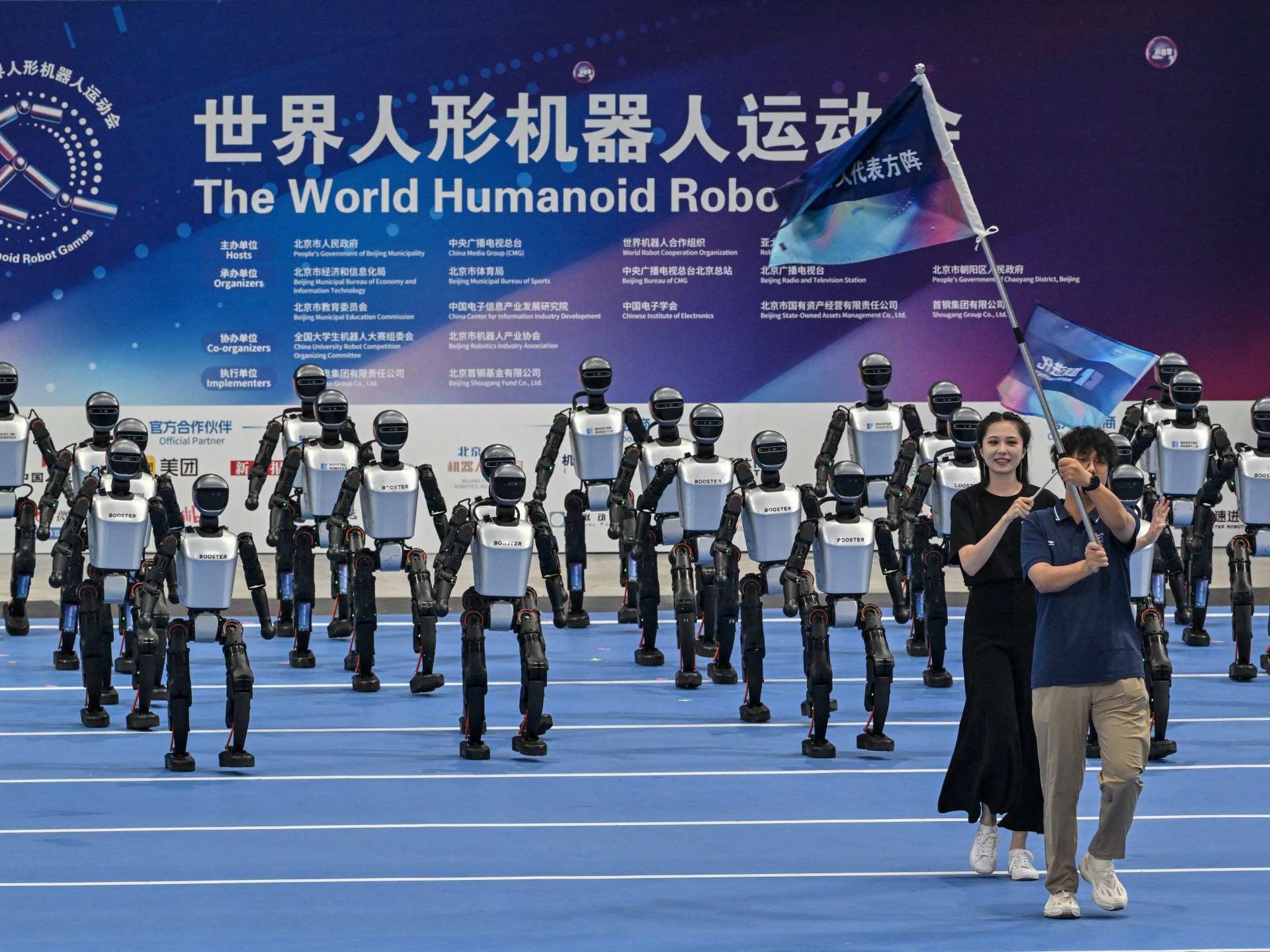
Image via Al Jazeera
Thursday, September 11, 2025
Why Your LLM Keeps Giving Different Answers
Mira Murati's lab cracked a fascinating puzzle: LLM outputs aren't actually inconsistent because of floating-point errors, but rather batch invariance issues (wild, right?). Meanwhile, Google just dropped an AI system that automates code generation for scientific research across six domains, while China flexed its robotics prowess with its inaugural Humanoid Robot Games. Oh, and VMware's trying to stay relevant by bolting AI onto legacy infrastructure, and educators are breathing a sigh of relief as reporting confirms AI will augment teaching, not replace it (yikes, close one). Would you trust batch invariance over floating-point fixes?
Image via Al Jazeera
Top Stories
LLM inference nondeterminism is caused by batch-size dependent kernel implementations rather than floating-point arithmetic, and can be solved through batch-invariant kernel design, enabling reproducible inference and true on-policy RL training.
Al Jazeera
China's first World Humanoid Robot Games demonstrated both the promise and current limitations of humanoid robots, while highlighting Beijing's strategic bet on robotics as a key technology for global competitiveness through massive government investment.
Artificial Intelligence News
VMware is cautiously integrating AI into its platform to remain competitive, but its real competitive moat remains the high switching costs of legacy virtualization infrastructure that lock in enterprise customers despite licensing controversies.
ABC News
While AI poses theoretical risks to teaching jobs, education leaders stress AI should augment rather than replace teachers, with the real priority being teacher training and retention in a sector already facing critical shortages in STEM and special education.
Google's new AI system automates scientific software generation using Gemini, achieving expert-level performance across six challenging research domains and reducing code optimization cycles from months to days. This breakthrough enables scientists to systematically explore hundreds or thousands of solutions while freeing researchers to focus on creative and critical challenges.
Keep Reading
Industry Voices
Cyrus Rashtchian
Research Scientist at Google Research
Publishes cutting-edge research on vision-language models and multimodal learning that often previews Google's next product features.
Emad Mostaque
Former hedge fund manager and creator at Stable Diffusion
Brings a contrarian open-source philosophy to AI development and isn't afraid to publicly challenge the closed approaches of major labs.
Adam Tauman Kalai
OpenAI
Leads explorations into using language models for social good and education, showing practical applications beyond chatbots and code generation.
Liam Fedus
Co-founder, Former VP of Research at Periodic Labs
Co-authored the Mixture-of-Experts paper behind GPT-4's architecture and shares insights on scaling transformers efficiently.
Eric Horvitz
Chief Scientific Officer at Microsoft
Bridges decades of classical AI research with modern deep learning while shaping how Microsoft deploys AI across its enterprise stack.
Enjoyed this issue?
Get daily AI intel delivered to your inbox. No fluff, just the stories that matter.